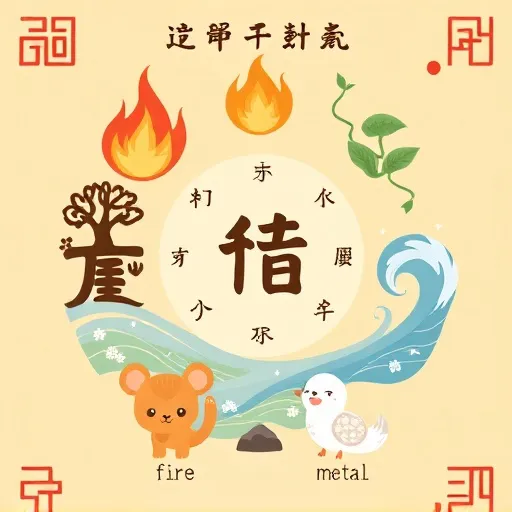
Five elements of Wu
What Are the Five Elements in Chinese Astrology?
If you've ever wondered what are the five elements in Chinese astrology, you're in the right place. The short answer: they're Wood, Fire, Earth, Metal, and Water — often called the Wu Xing. That's it. Five categories that ancient Chinese philosophy used to map how energy moves, transforms, and interacts with everything around us. And in Chinese astrology, these five elements don't just sit there like static labels. They're constantly flowing into each other, feeding each other, and occasionally pushing back. Understanding what are the five elements in Chinese astrology is really about understanding motion, not memorizing a list.
Here's the part most people gloss over: the five elements aren't abstract symbols floating in space. In a Chinese astrology chart, they team up with the twelve zodiac animals and the whole yin and yang framework to build a surprisingly detailed picture of someone's personality, tendencies, and timing. Think of your zodiac animal as the flavor and your element as the fuel. That combo is why two people with the same sign can feel completely different — and it's the first thing to grasp when you ask what are the five elements in Chinese astrology.
Each element carries its own season, direction, color, emotion, and body system. That's how practitioners can glance at a chart and say things like "you're running hot on Fire this year" or "your Wood is a little depleted." It's an entire diagnostic language — and honestly, once it clicks, you'll start seeing what are the five elements in Chinese astrology reflected everywhere.
Wood, Fire, Earth, Metal, and Water: The Core Wu Xing Energy Framework Explained
Let's walk through each element so you actually get what they represent — not just the label on the box.
Wood — Growth, Vision, and Creativity in the Spring Season
Wood is spring. It's the energy of a seed shoving its way through soil. In Chinese astrology, Wood represents ambition, creativity, planning, and expansion. People with strong Wood tend to be visionary, a little idealistic, and great at starting things — sometimes less great at finishing them. Traditional thinking links Wood to the liver and gallbladder, and its emotion is anger (or frustration when growth gets blocked). If you're exploring what are the five elements in Chinese astrology for personality purposes, Wood is where you look for someone's drive and sense of direction.
Fire — Passion, Expression, and Charisma During the Summer Season
Fire is summer — heat, charisma, and the urge to be seen. In Chinese astrology, Fire governs enthusiasm, communication, and emotional expression. Strong Fire types are magnetic and warm, often the center of the room — but they can burn out fast without pacing. Fire links to the heart and small intestine, and its emotion is joy, which flips into anxiety or overexcitement when unbalanced. Ask what are the five elements in Chinese astrology and Fire is usually the one people already recognize in themselves.
Earth — Stability, Nourishment, and Trust Between the Seasons
Earth is the transition between seasons — the grounding force in the middle of the cycle. In the five elements system, Earth means reliability, patience, and care. Earth-heavy people hold things together, keep promises, and make excellent long-term planners. The flip side? They can get stuck in routine or resist change in the name of stability. Earth connects to the spleen and stomach, and its emotion is worry. This is a big piece of what are the five elements in Chinese astrology — the element everyone forgets but everyone needs.
Metal — Structure, Clarity, and Discipline in the Autumn Season
Metal is autumn — harvest time, cutting away what's no longer needed, getting precise. In Chinese astrology, Metal rules discipline, logic, organization, and a strong sense of justice. Metal types are sharp, principled, and excellent editors — of documents, business plans, or their social circle. Metal relates to the lungs and large intestine, and its emotion is grief, especially when things feel unresolved. When people ask what are the five elements in Chinese astrology and want the "tough love" one, this is it.
Water — Wisdom, Intuition, and Adaptability in the Winter Season
Water is winter — the element of intuition, introspection, and flow. In Chinese astrology, Water represents intelligence, flexibility, and emotional depth. Water-heavy people are deeply perceptive, quietly strategic, and remarkably good at adapting. Water connects to the kidneys and bladder, and its emotion is fear — which, managed well, becomes courage. Rounding out what are the five elements in Chinese astrology with Water shows how the whole system loops back to growth.
The Productive Cycle and Controlling Cycle: How the Five Elements Interact
Here's where it gets genuinely interesting. The five elements don't just exist side by side — they follow two governing cycles that explain almost everything about how they behave in a chart.
- The Productive Cycle (Sheng): Wood feeds Fire, Fire creates Earth (ash), Earth produces Metal, Metal carries Water, and Water nourishes Wood. This is the support loop — it shows how energy flows and builds.
- The Controlling Cycle (Ke): Wood controls Earth, Earth controls Water, Water controls Fire, Fire controls Metal, and Metal controls Wood. This is the balance loop — it stops any single element from dominating.
When you see a Chinese astrology chart, a practitioner is basically checking: is this person's energy flowing smoothly through the productive cycle, or is something being over-controlled? That balance — or lack of it — is where readings get their nuance. Honestly, this is the answer to what are the five elements in Chinese astrology that most beginner articles skip entirely.
Zodiac Animals and Their Fixed Elements: The Twelve Zodiac Signs Connection
Each of the twelve zodiac animals is tied to a fixed element, and every year also carries its own element. So your full picture is a blend — your animal's inherent element plus the element of your birth year.
- Wood: Tiger and Rabbit
- Fire: Snake and Horse
- Earth: Ox, Dragon, Goat, and Dog
- Metal: Monkey and Rooster
- Water: Rat and Pig
Then there's the year element, which rotates on a ten-year cycle. For 2026, we're in a Fire Horse year — Fire on top of Fire, which traditional practitioners describe as an especially intense, expressive, fast-moving stretch. If you want to understand why 2026 feels like a lot, start with the five elements and you'll see it quickly. This layered view of what are the five elements in Chinese astrology is where the real depth lives.
Birth Element and Chinese Zodiac Element: Your Four Pillars Analysis Starting Point
In Chinese astrology, the most useful personal data point is often your birth element — the element attached to the year you were born. It's a common entry point for anyone curious about their Chinese zodiac element, and usually the first thing a practitioner checks. But here's the pro insight most articles skip: your birth element isn't the whole story. A proper Chinese astrology reading looks at the full four pillars — year, month, day, and hour — because the day pillar often carries more weight for personality, and the hour pillar reveals hidden influences. Two people born in the same year can have very different element profiles. That's also why five elements analysis is such a popular search right now. People want to know: which element am I lacking? Which one am I overloaded with? And how do I balance it? Those questions are the practical side of what are the five elements in Chinese astrology.
Element Balancing Through Colors, Directions, and Lifestyle Habits
If you're curious about element balancing, the traditional approach is surprisingly practical. Bring in more of what you lack and gently temper what's excessive — through environment, habits, colors, and timing. Here are the general associations:
- Wood: Green, east, spring, plants, planning sessions, growth-oriented goals
- Fire: Red, south, summer, sunlight, social activity, creative expression
- Earth: Yellow and brown, center, late summer, routines, grounding practices
- Metal: White and metallic tones, west, autumn, decluttering, structured systems
- Water: Black and blue, north, winter, rest, reflection, deep learning
One responsible note: the five elements are a symbolic framework, not a medical system. A lot of modern content drifts into health claims that don't hold up. Treat element balancing as a lens for self-reflection and lifestyle design, not a replacement for professional advice. Most credible practitioners in 2026 frame it exactly that way — which is the honest way to approach what are the five elements in Chinese astrology.
Common Misconceptions About the Five Elements and Chinese Astrology Compatibility
Let's clear up a few things people get wrong all the time:
- Myth: "My element is fixed forever." Reality: Your birth element is fixed, but your chart's balance shifts with time, and yearly elements interact with your chart in different ways.
- Myth: "More of my element is always better." Reality: Excess can be as tricky as deficiency. The goal is flow, not maximum.
- Myth: "The five elements are the same as Western astrology's elements." Reality: Western astrology uses four elements (fire, earth, air, water). The Chinese system uses five, with completely different logic and cycles.
- Myth: "It's purely superstition." Reality: It's a symbolic and philosophical framework. Whether you treat it as a personality tool, a cultural tradition, or entertainment is up to you.
The five elements — Wood, Fire, Earth, Metal, and Water — are the operating system of Chinese astrology. The zodiac animals get all the attention, but the elements are what give a reading its depth. Once you understand the productive cycle and controlling cycle, you can read almost any chart with way more confidence. And if you're wondering where to start personally, look up your birth year's element first, then dig into your full Chinese astrology birth chart. You might be surprised at how accurately the combination describes your natural tendencies — and 2026 is a great year to start exploring what are the five elements in Chinese astrology for yourself.