Feng shui desk direc
Why Desk Direction Matters More Than You Think
Let's cut to the chase: feng shui treats your desk as your own personal command center. The feng shui office desk facing direction you choose shapes how chi — that's energy — flows around you and toward you throughout the workday. Sit facing the wrong way, and you'll likely feel scattered, drained, or like you're getting interrupted every five minutes. Nail the right feng shui office desk facing direction, though, and work starts to feel smoother, decision-making gets easier, and those opportunities somehow seem to find you more often. Funny how that works, right?
Here's the thing — from a workplace psychology standpoint, this lines up neatly with what researchers call "environmental control," meaning the sense that you can actually manage your surroundings. Whether you buy into the metaphysical side of feng shui or not, the practical outcome stays the same: a well-positioned desk makes you feel more in charge of your day. And that's a productivity win no matter how you slice it. The feng shui office desk facing direction principle works on your psychology first — everything else follows.
One seasoned practitioner I spoke with put it bluntly: "You don't have to believe in the energy to benefit from the setup. The setup works on your psychology first." That's a refreshingly grounded take, and it's the lens we'll use throughout this guide. Think of feng shui office desk facing direction as environmental design with a few thousand years of trial and error behind it.
The Classic Command Position Rule in Feng Shui Office Desk Facing Direction
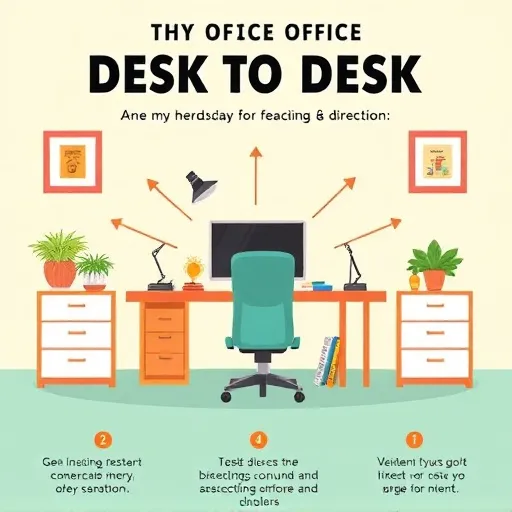
Before we get into compass directions, let's cover the non-negotiable foundation. In feng shui office desk facing direction, the command position comes first. Everything else is secondary. The command position means you can see the door without straining — ideally on a slight diagonal from your seat. Your back is against a solid wall, never facing a doorway or a high-traffic walkway. You're not directly in line with the door, so energy doesn't blast straight at you. And no windows directly behind you if avoidable — a solid backing symbolizes support.
Why does this matter so much? Because sitting with your back to an entrance triggers a low-grade vigilance response. You can't see who's approaching, so part of your brain stays on guard. Over weeks and months, that's exhausting. Flip it around — back to the wall, door in view — and your nervous system settles. That sense of security is the doorway to deep work. One senior industry professional described it to me this way: "The command position is the difference between working in a fortress and working in a hallway. You want the fortress." Couldn't have said it better — and this is exactly why feng shui office desk facing direction starts with layout, not compass readings.
Compass Directions and Elemental Energy for Your Feng Shui Office Desk Facing Direction
Now for the part everyone asks about. Once you've nailed the command position, you can fine-tune your feng shui office desk facing direction with compass directions. Traditional feng shui ties each direction to an element, a life area, and a type of energy. Facing north is associated with water, which governs career momentum and the flow of opportunities — great for client relationships and project management. Facing east channels wood energy: growth, renewal, and fresh ideas, which makes it fantastic for creatives, strategists, and founders. A small plant nearby reinforces the wood element.
Facing south represents fire: visibility, reputation, and passion — traditionally recommended for sales professionals, marketers, and anyone gunning for a promotion. Just watch out, because fire energy can run hot if you're already prone to burnout. Facing west is tied to metal and the energy of finishing things — perfect for editors, reviewers, and anyone wrapping up projects. Facing southeast combines wood and the wealth sector, a popular pick for entrepreneurs and freelancers whose income depends on deals closing. Northeast is the knowledge and wisdom sector for researchers and analysts, while southwest governs relationships and partnerships — smart for HR and collaborative roles. Your ideal feng shui office desk facing direction really depends on what you're trying to achieve.
Form School vs. Compass School When Choosing Your Feng Shui Office Desk Facing Direction
Here's where a lot of people get stuck. There are two main schools of thought, and they occasionally disagree. The form school focuses on the physical layout — command position, flow of foot traffic, sight lines. This is the practical, universal layer. The compass school uses your personal kua number (derived from your birth year and gender in traditional systems) to identify favorable and unfavorable directions.
My advice? Start with form school. Get the command position right before you obsess over compass degrees. The layout rules apply to everyone and deliver immediate, tangible benefits. Once that's locked in, layer in the compass direction that matches your goals and, if you're so inclined, your personal kua number. One veteran in workplace design told me, "Ninety percent of people feel the difference within a week of fixing their command position. The compass tuning is the icing, not the cake." Practical tip: you don't always have the luxury of rearranging a whole office. If your ideal feng shui office desk facing direction is blocked by a wall or doorway, work with what you have — nudge your desk a few degrees, add a mirror to expand the sense of space, or place a screen to soften a harsh sight line. Feng shui is about improvement, not perfection.
Common Feng Shui Office Desk Facing Direction Mistakes and Quick Fixes
Let's talk pitfalls. Even people who've read up on feng shui office desk facing direction trip over these. Facing a blank wall at close range creates a "blocked" feeling and stifles creativity — if you must, keep it at least a meter away and hang something inspiring. A desk directly facing the door means energy hits you head-on, which feels aggressive and distracting, so shift to a diagonal instead. Back to a window symbolizes a lack of support (plus glare), so use a solid-backed chair and a curtain. Clutter under and around the desk collects stagnant energy — a clean workspace is half the battle. And a desk in the direct path of a corridor creates sha chi (rushing energy), so reposition or use a partition.
Each mistake has a psychological explanation too, which is why the practice feels so intuitive once you learn it. Blocked views feel blocked. Open, supported positions feel secure. The ancient wisdom and modern ergonomics keep agreeing with each other — and that's the real beauty of getting your feng shui office desk facing direction right. Direction alone isn't the whole story, though. Natural light should fall across your desk rather than glare into your eyes. A healthy plant reinforces growth energy and improves air quality. Color accents carry element associations — greens for wood, blues for water, reds for fire — and a mug or notebook in the right shade does the job. Position your monitor so it doesn't reflect a doorway, and consider a small mirror to symbolically extend your command position.
Your Step-by-Step Feng Shui Office Desk Facing Direction Checklist
Ready to optimize? Here's the sequence I recommend. Step 1: Identify the command position — back to a solid wall, door visible on a slight diagonal. Step 2: Check the view — if you're staring at a wall or corridor, rotate or reposition. Step 3: Match your feng shui office desk facing direction to your work goals — north for flow, east for ideas, south for visibility, west for completion, southeast for wealth, northeast for learning, southwest for relationships. Step 4: Clear the space — remove clutter and get rid of anything broken. Step 5: Add supporting elements — lighting, a healthy plant, a color accent matching the element. Step 6: Test it for a week and notice your focus, your interruptions, and how you feel at the end of the day.
That last step is the one people skip, and it's the most important. Feng shui is empirical in its own way — you adjust, you observe, you refine. Treat your feng shui office desk facing direction like A/B testing for your workspace. Even in a cubicle, you can angle your chair toward the opening, add a small mirror, and control desktop clutter. If your desk faces a direction you don't love but can't move it, work the other layers — a solid-backed chair, a screen behind you, a plant at the corner, and intentional lighting soften an unfavorable direction considerably. The direction you face while working usually matters most, but keep desk and chair aligned for comfort. And yes, feng shui is remarkably compatible with modern ergonomics — both favor support, stability, clear sight lines, and good lighting. Whether you're chasing flow, ideas, visibility, or wealth, there's a feng shui office desk facing direction that supports it. All you have to do is turn your chair.